
 Thinker X400
 LCD 3D Printer L10
 Hyper Speed TPU
 Standard TPU 90A Filament
 Standard TPU 95A Filament
 TPU Rainbow-95A
 Ultra Silk PLA
 Standard PLA
 Silk Tri-color PLA
 More
 Standard PETG
 PETG-GF
 PETG-CF
 Hyper Speed PETG
 PA6/12-GF
 Standard ASA
 Hyper Speed ASA
 ASA Glass Fiber
 ASA Carbon Fiber
 ABS Glass Fiber
 ABS Carbon Fiber
 Hpyer Speed ABS Filament
 Water Washable Resin
 Low Odor Resin
 ABS Like Resin


Thinker X400 In-Depth Review: Redefining the Speed and Scale of Industrial-Grade 3D Printing
Shocking from the moment you open the box: When the "giant printer" enters the studio
Upon first glance, the Eryone Thinker X400's 130-pound (approximately 59kg) weight and 27×25×32-inch dimensions immediately suggest its "industrial-grade" status. The fully enclosed acrylic casing with removable panels creates a professional feel while facilitating maintenance. The most ingenious feature is the four-legged caster design: rotating the red knob switches between movable casters and shock-absorbing mounting, balancing flexibility and printing stability.
Operation on the 5-inch touchscreen is smooth, and users familiar with the Klipper firmware can quickly get started. The built-in HD camera also supports remote monitoring of the printing progress.

Breakdown of Core Parameters: A Two-Way Breakthrough in Speed and Precision
1. 64-liter mega-cabin: Saying goodbye to the era of "split-printing"
Its biggest highlight is its 400×400×400mm molding space (approximately 64 liters). In actual testing, it can simultaneously mass-produce 20 small mechanical parts, completely eliminating the hassle of later assembly. For architectural design studios, it can even directly print 1:20 scale floor plans, with a level of detail far exceeding that of assembly-based solutions.

2. 500mm/s Surge: Efficiency increased by 300%
The CoreXY structure gives it astonishing speed: a maximum printing speed of 500mm/s + 10,000mm/s² acceleration, three times that of a typical commercial printer. Printing a 140×100×125mm model with matte gradient PLA takes only 4.5 hours, while similar equipment typically takes more than 10 hours. Even more remarkable is that the speed does not sacrifice accuracy; with an adjustable layer thickness of 0.08-0.32mm, the tooth error of printed ABS gears can be controlled within 0.1mm.

3. Full Material Compatibility: From PLA to Carbon Fiber Composites
The combination of a 300℃ nozzle and a 120℃ heated bed allows it to handle almost all mainstream filaments: basic materials like PLA and PETG are no problem, and it can stably output TPU (≤95A), ASA, nylon, and even carbon fiber composites. During testing with the LM Flash Green PLA, the direct-drive extruder fed the filament evenly with no nozzle clogging issues; while when printing PA-CF parts, the fully enclosed chamber and activated carbon filter effectively suppressed odors.

Intelligent Manufacturing Ecosystem: More Than Just "Printing"
1. Fully automated calibration system
The 25-point grid auto-leveling and four independent Z-axis design are incredibly convenient! No manual intervention is needed after startup; the machine automatically detects platform flatness and compensates for errors. The high adhesion of the first layer perfectly solves the problem of edge curling. Combined with a double-sided magnetic PEI plate, parts can be easily removed by gently bending after printing, protecting model edges and extending platform lifespan.

2. Print Farm-Level Management
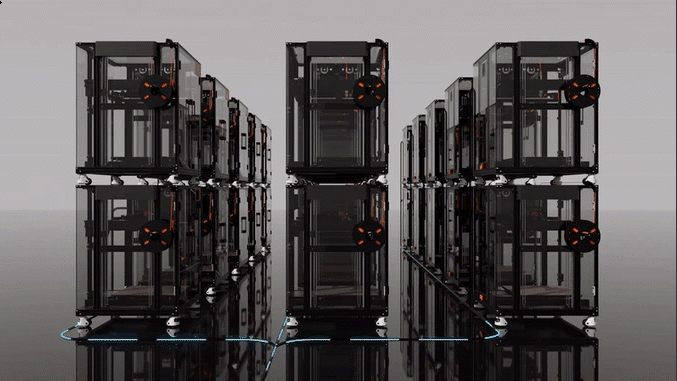
Multi-machine network control can be achieved through dedicated production software: batch sending of tasks, automatic queuing for printing, and remote start and stop operations, making it particularly suitable for small printing farms.
Who should buy it? Three core user profiles
- Makers/Studios: Large size + multiple material properties, suitable for making large figurines, prop models or functional prototypes.
- Small and medium-sized enterprises: 500mm/s speed + batch printing capability can shorten small-batch production cycles by more than 60%.
- Research institutions: Carbon fiber composite material printing capabilities enable rapid iteration of experimental mechanical parts.
Purchase Recommendation: The King of Value for Money?
Currently priced at $2199 (originally $2499), it's highly competitive compared to comparable industrial printers that often cost $5000. If you need: ① a single print size ≥ 400mm ② more than 50 hours of printing per month ③ frequent switching of engineering materials, then the X400 is definitely one of the most worthwhile 3D printers to buy in 2025.